Home / Mold guide / Cleaning products
Bleach, Vinegar, Fogging and Ozone: What Cleans Mold
Every mold question online ends in a product. Here is what the CDC and EPA say about cleaning, what they do not say, and where the marketing gets ahead of the evidence.
The short answer
The EPA says to scrub hard surfaces with detergent and water and dry them completely. The CDC adds that bleach is acceptable at no more than 1 cup per gallon of water, and must never be mixed with ammonia. Neither page we reviewed endorses fogging or ozone. Fix the moisture first, or mold returns.
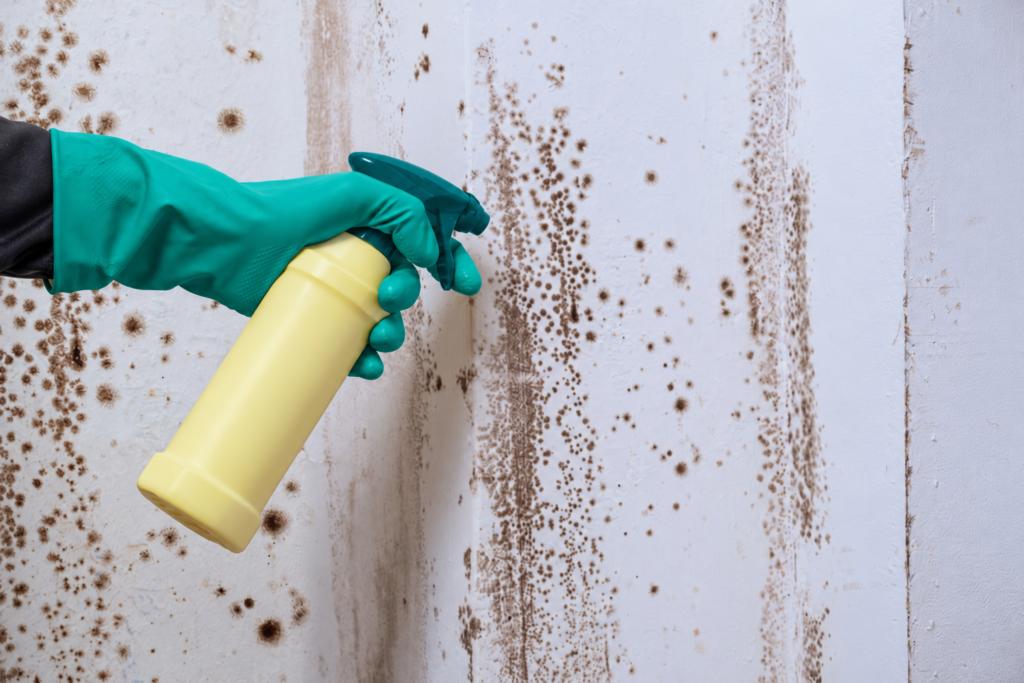
What the agencies say
Short list
| Product | What we found |
|---|---|
| Soap or detergent and water | EPA: scrub hard surfaces, then dry completely. CDC: household products or soap and water are fine |
| Bleach | CDC: no more than 1 cup per gallon of water. Never mix with ammonia or other cleaners. Ventilate the area |
| Vinegar | The CDC and EPA pages we reviewed give no guidance on vinegar |
| Hydrogen peroxide, borax, tea tree oil | Not covered on the CDC or EPA pages we reviewed |
| Fogging and ozone | The EPA mold cleanup page does not mention them |
| Paint or caulk over mold | EPA: do not. Paint on moldy surfaces is likely to peel |
| Sealants and biocides in ducts | EPA: be cautious. Their effectiveness and safety are not well established |
Not covered does not mean it does not work. It means we could not find a public-health source behind it, so treat product claims as marketing until a source says otherwise.
Safe small cleanup
Hard surfaces, under about 10 square feet
- Fix the moisture source.
- Wear long gloves, goggles without ventilation holes, and an N-95 respirator that fits (EPA). The EPA says an N-95 costs about 12 to 25 dollars.
- Scrub with detergent and water, then dry completely.
- Throw away porous material that stays moldy, such as ceiling tiles and carpet.
- Never mix bleach with ammonia or other cleaners (CDC).
See can I clean mold myself for the size limit.
Be skeptical
Claims to question
- A fog or spray that kills all mold forever. The EPA says mold control is moisture control.
- A treatment sold without removing the damaged material.
- Sealing or encapsulating mold without fixing the water.
- A price line for fogging with no scope of work behind it.
Read how to read a quote and scams and red flags.
Start here
Detergent and water do most of the work
EPA says that mold on hard, non-porous surfaces can usually be removed with detergent and water, followed by thorough drying. Scrubbing physically removes the growth. A product that only changes the color of a stain does not remove the mold underneath.
Bleach
Where it helps and where it does not
The CDC says that if you use bleach, mix no more than 1 cup per gallon of water, ventilate the room and never combine it with ammonia or other cleaners. Bleach is a surface disinfectant. It does not penetrate porous materials like drywall, wood or ceiling tile, so the mold roots can survive inside the material while the surface looks clean. EPA does not recommend routine bleach use for mold cleanup.
Vinegar and others
Common home remedies
- White vinegar: a mild acid some people use on small hard-surface patches. It has a strong smell and is not a substitute for fixing moisture.
- Hydrogen peroxide: sometimes used on hard surfaces; test on a hidden spot because it can lighten finishes.
- Baking soda or borax: mild cleaners with scrubbing action; borax should be kept away from children and pets.
- Commercial mold sprays: read the label for the surfaces and the ventilation needed. EPA says biocides are generally not required and can themselves be hazardous.
Never mix cleaning products. Some combinations release toxic gas.
Ozone and fogging
Why we do not recommend them
Ozone generators and foggers are sometimes sold as whole-house fixes. EPA says ozone can irritate the lungs and has little effect on removing indoor pollutants at levels that meet health standards. Fogging a room without removing the growth leaves the cause and the material in place. See air purifiers, HEPA and mold.
The bigger picture
Products do not fix moisture
If mold keeps returning after cleaning, the cause is water or humidity, not the cleaner. Fix the leak, run a dehumidifier and keep humidity between 30 and 50 percent. See why mold keeps coming back.
More questions
More questions, answered
Does vinegar kill mold
It may help on a small hard-surface patch, but EPA and CDC guidance centers on detergent and water. It does not fix a moisture problem.
Can I mix bleach and vinegar
No. Mixing bleach with acids or ammonia releases toxic gas. Never combine cleaning products.
Is it safe to run an ozone machine
EPA says ozone can irritate the lungs and is not an effective way to remove mold. We do not recommend it.
Is a store-bought mold remover enough
For a small, hard-surface patch it can be. If the growth is on drywall, wood or insulation, or is larger than about 10 square feet, the material usually has to be removed or professionally cleaned.
Is a store-bought mold remover enough
For a small, hard-surface patch it can be. If the growth is on drywall, wood or insulation, or is larger than about 10 square feet, the material usually has to be removed or professionally cleaned.
Is a store-bought mold remover enough
For a small, hard-surface patch it can be. If the growth is on drywall, wood or insulation, or is larger than about 10 square feet, the material usually has to be removed or professionally cleaned.
Questions
Common questions
Does vinegar kill mold?
The CDC and EPA pages we reviewed do not address vinegar. They recommend soap and water or, per the CDC, a limited bleach solution on hard surfaces, followed by drying.
Is bleach safe on mold?
The CDC allows no more than 1 cup per gallon of water on hard surfaces, with ventilation and protective gear. Never mix it with ammonia. Bleach is not appropriate for every material.
Does mold fogging work?
The EPA mold cleanup page does not mention fogging. If a company proposes it, ask what it replaces and what source supports it.
Sources
Sources and review
- U.S. CDC, About mold
- U.S. EPA, Mold cleanup in your home
- U.S. EPA, A Brief Guide to Mold, Moisture and Your Home
- U.S. EPA, Should you have the air ducts in your home cleaned
Last updated November 8, 2026.
This page is general information, not medical advice. If you or someone in your home has symptoms, talk to a doctor.
Keep reading
Related guides
- Can I clean it myself?The 10 square foot line.
- Scams and red flagsFear selling.
- Air purifiers and HEPAWhat they do.
Get a quote
Get a written quote for your Gainesville mold problem
Send a few photos and a short description, and PureGuard Restoration will come back with a written scope of work and price. We will get back to you as soon as we can.
- Call(352) 668-9909
- Text photos(352) 668-9909
- Emailcontact@moldremediationofgainesville.com
- Or use the formName, phone, ZIP code, and what happened.
Ask for the license number when someone calls you back. You can check it on the state lookup.
About us: PureGuard Restoration is a mold remediation company serving Gainesville and Alachua County. We do not test for mold.
Request your written quote
What helps most in the first message
- Where the mold is and roughly how big it looks. A coin, a hand or a sheet of paper next to it helps.
- Where you think the water came from, and whether it’s fixed.
- When you first noticed it, and whether there was a leak, storm or AC problem before that.
- Whether you own, rent or manage the property, and whether you plan to involve insurance.